Yes, it’s hard for the first few minutes. Not hard in a you need lessons for weeks way. Hard in a your brain has built the opposite habit for years and it takes a moment to overwrite it way. Most people don’t struggle because they’re bad drivers. They struggle because their instincts are doing their best to help, and in reverse steering that help comes out backwards.
The good news is the learning curve is steep in the right direction. It feels odd, then it clicks, and once it clicks you’re not guessing anymore. You’re controlling it.
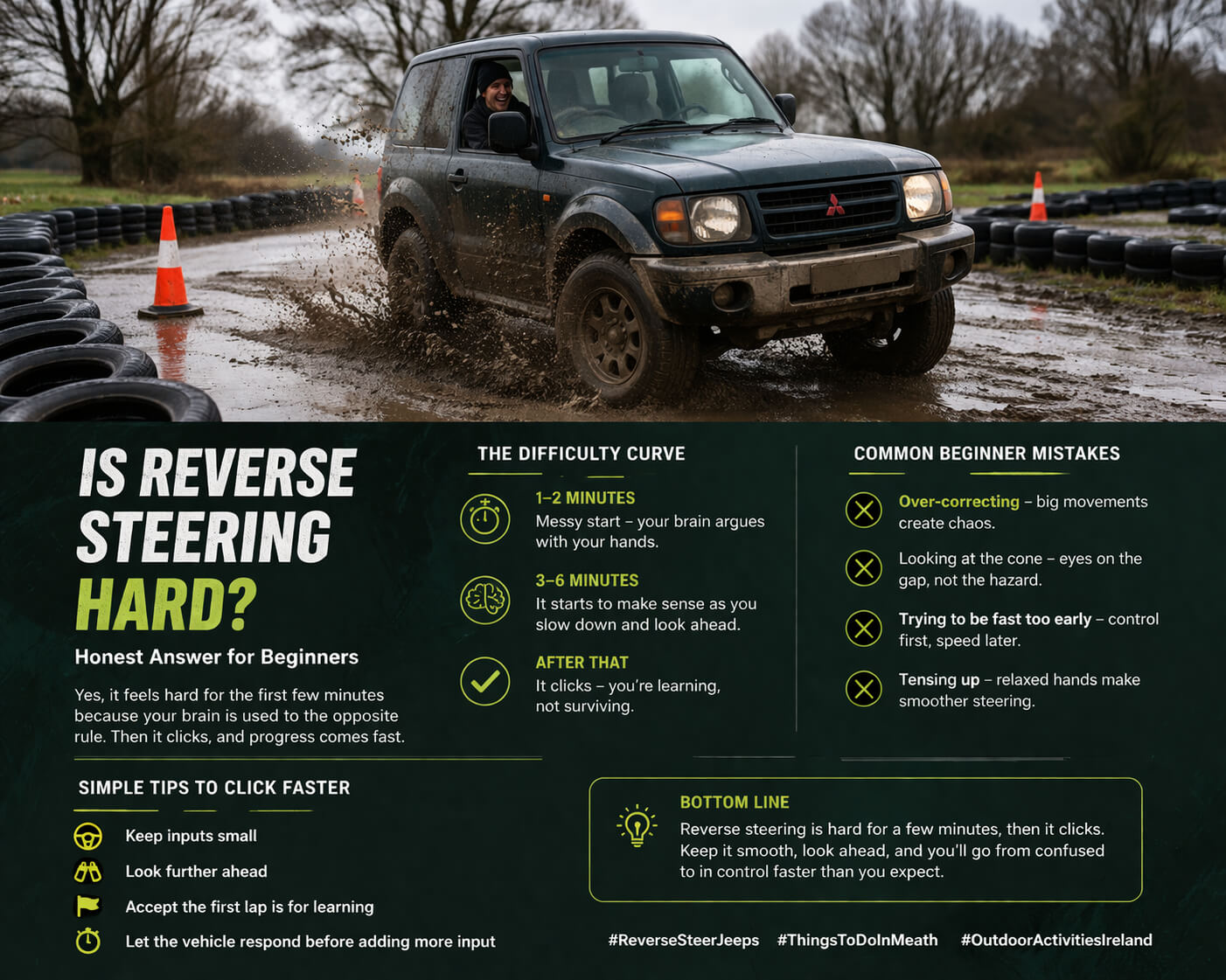
The honest difficulty curve
Reverse steering has a very predictable pattern for beginners. Knowing that pattern helps, because it stops you thinking you’re the only one finding it weird.
First 1–2 minutes: your brain argues with your hands
You turn the wheel like you always do. The vehicle responds the opposite way. You try to fix it quickly, and you usually make it worse because you correct the wrong way again. This is the messy part, and it’s totally normal.
Minutes 3–6: it starts to make sense
You begin to slow your hands down. You stop fighting it. You look further ahead. The vehicle starts responding the way you expect, because your expectation has changed.
After that: you’re learning, not surviving
Once you’ve had a few corners where you keep calm and tidy, you stop reacting late and start predicting what will happen. That’s the click. After that, progress comes fast.
Why it feels harder than it is
Reverse steering feels harder than it is because it breaks a deeply trained habit. Driving is mostly muscle memory. You don’t think about steering input, you just do it. Reverse steering forces you to think again, and that feels uncomfortable because it slows you down at the start.
The real task is not physical. It’s mental. You’re updating a rule inside your head: wheel direction no longer matches movement direction the way it used to.
Muscle memory is confident and wrong
Muscle memory reacts instantly and insists it’s right. Thinking brain is slower but correct. The first few minutes are just the handover from one to the other.
Common beginner mistakes
These are the classics. If you do them, you’re in good company.
Over-correcting
Big steering movements create big problems. If you correct hard in the wrong direction, you then correct hard again, and you end up chasing the line. The fix is smaller inputs, earlier, and less panic.
Looking at what you want to avoid
If you stare at a cone or a tyre wall, you drift toward it. That’s not mystic driving talk, it’s just how humans steer. Look at your line, not at the hazard.
Trying to be fast too early
Speed multiplies confusion. First you learn the response. Then you build pace. People who try to win on their first lap are usually the ones doing the most dramatic zig-zagging.
Tensing up
Tension makes your hands snatchy. Snatchy hands create chaos. Breathe, loosen your grip a touch, and guide rather than wrestle.
The simple tips that make it click faster
You don’t need a long list. A few basics cover 90 percent of what beginners need.
Keep steering inputs small
Small inputs give you time to see the response and adjust cleanly. Big inputs force you into emergency corrections.
Look further ahead
If you only look at what’s right in front of you, you’re always late. Looking ahead buys you time, and time makes reverse steering feel calm.
Accept the first lap is for learning
Your first lap isn’t a performance. It’s the calibration phase. Once you accept that, you relax, and you learn faster.
Let the vehicle respond before you add more input
Beginners often stack inputs too quickly. Turn a little, wait a beat, feel the response, then adjust. It’s smoother and far more controlled.
Who typically learns fastest
Not always the “best driver” in the group. Often it’s the person who’s happy to be patient for two minutes and follow the basics. Reverse steering rewards restraint.
What “fast learners” usually do
- they listen to the induction and actually try it
- they keep their hands calm
- they look ahead and pick a line
- they don’t try to impress anyone on lap one
If you’re nervous, here’s the honest reassurance
Nerves are normal because it feels unfamiliar, not because it’s unsafe. The guided start is there specifically to remove the guesswork. You’re not expected to arrive confident. You’re expected to arrive willing to try. Once you get a couple of corners done cleanly, confidence tends to show up on its own.
If you’re coming with a partner or friends and one person is unsure, that’s common as well. The format works best when everyone gets the same calm start and nobody is pushed into trying to prove something.
Bottom line
Reverse steering is hard for a few minutes because your brain is trying to use the wrong rule. Then it clicks. Most beginners go from messy to controlled faster than they expect, especially when they keep inputs small, look ahead, and treat the first lap as learning time. Once it clicks, the fun is obvious.