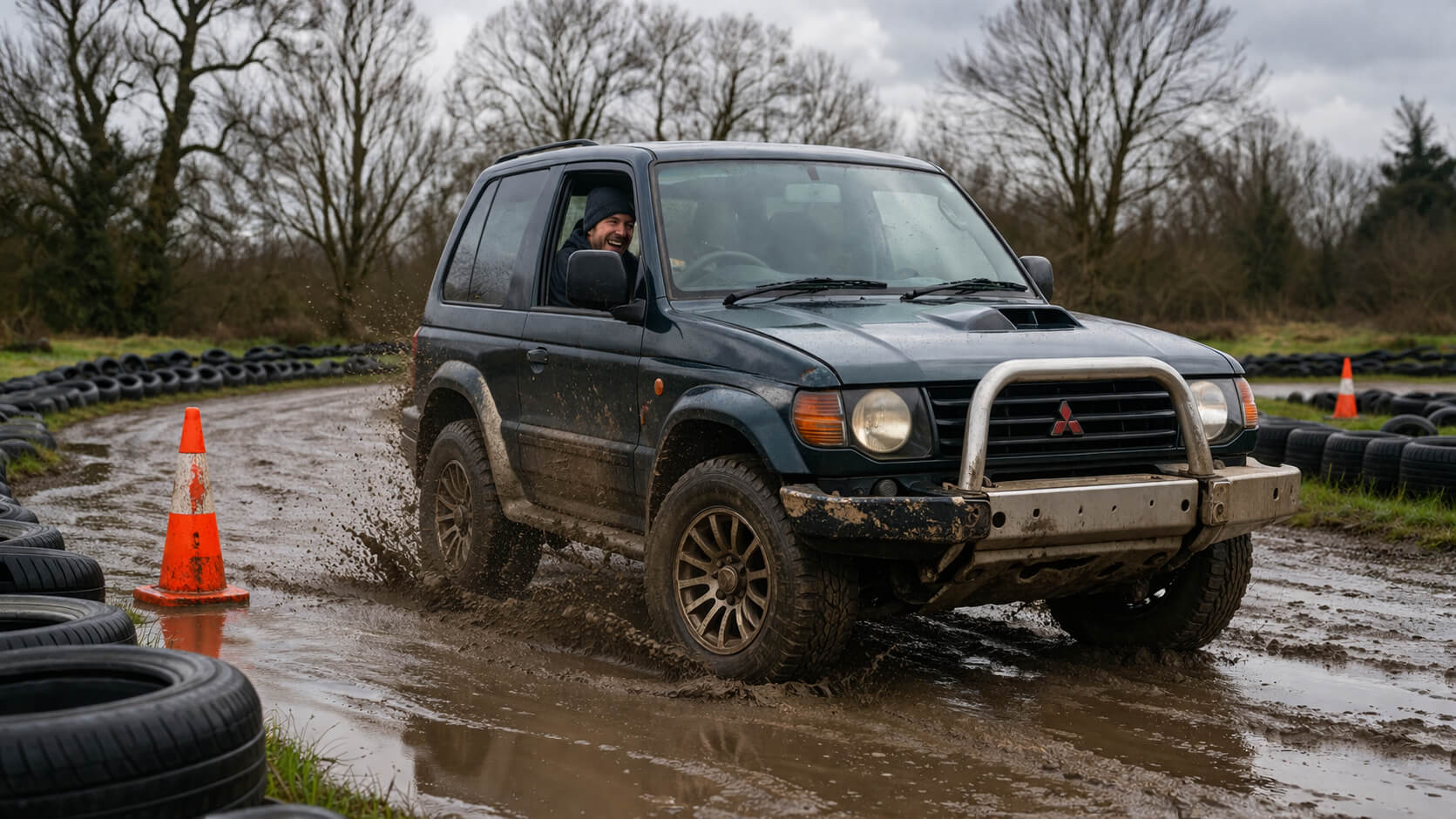
Reverse steering sounds like a prank until you try it. You turn the wheel right and the vehicle goes left. Your brain immediately decides this is wrong, dangerous, and probably someone’s idea of a laugh at your expense. Then, oddly quickly, it starts to make sense. That shift from what is happening to right, I’ve got it is the whole point of the experience.
This is a straight guide to what reverse steering actually is, why it feels so strange at the start, and why most normal adults figure it out faster than they expected. No heroic driving talk, no pretending it’s easy from second one. Just the truth of it.
What reverse steering actually is
Reverse steering means the steering response is flipped. The direction your hands move does not match the direction your tyres turn in the way you are used to. So when you try to correct a drift or line up for a corner using normal instincts, you do the exact opposite of what would help.
The key detail is this: reverse steering is not about strength, bravery, or speed. It is about control. It turns driving into a small skill puzzle where your brain has to update the rulebook.
The simple version
Right input gives left movement. Left input gives right movement. That is it. But your muscle memory treats that as an emergency.
Why it feels impossible at first
The first moments feel messy because two systems in your head are fighting. One is your thinking brain, trying to remember the new rule. The other is muscle memory, which reacts faster and is convinced the old rule still applies. Muscle memory usually wins the first argument, and that is where the funny bits happen.
It is also why people often start off over-correcting. You turn, see the wrong response, panic, turn more, and then suddenly you are chasing the line rather than driving it. That is normal. It is not a sign you are bad at driving. It is a sign you are human.
Muscle memory vs thinking
Muscle memory is quick, confident, and completely wrong for this task. Thinking is slower, a bit cautious, and correct. The goal is to give thinking a few minutes to take the wheel, literally and mentally, until the new response becomes the new habit.
The moment it clicks and what causes it
The click is not magic. It happens when you stop trying to fix everything at once and start making smaller inputs. The smaller your steering movements, the less dramatic the wrong response feels, and the easier it is to stay calm long enough to learn. Calm is not a personality trait here, it is a practical tool.
Once you do a few corners without panicking, your brain starts predicting the new response instead of reacting late to it. That is when it suddenly feels drivable, and you go from surviving to actually controlling the vehicle.
What usually triggers the click
- you slow down your hands, not necessarily the vehicle
- you look further ahead instead of staring at the problem in front of you
- you accept the first lap is for learning, not for looking good
- you stop wrestling it and start guiding it
Why most people learn it faster than they expect
People arrive thinking it will take ages because it feels backwards in theory. In practice, the learning is quick because the feedback is immediate. You do a small input, you see what it does, and your brain updates. It is like learning a new control scheme in a game, except you are outdoors, it is real, and you will definitely talk about it afterwards.
The guided start matters too. When someone explains what you should expect to feel in the first minute, you do not waste mental energy worrying that you are doing it wrong. You spend that energy learning instead.
What makes someone good fast
This part surprises people. The ones who learn quickest are not always the loudest or the boldest. The quickest learners tend to be the ones who listen to the simple instruction, make small inputs, and give themselves permission to be rubbish for about sixty seconds.
Reverse steering rewards restraint. If you drive it like it is a normal vehicle and you try to be decisive, it bites back. If you stay smooth and controlled, it starts behaving for you.
Spoiler: it is not bravery
Being brave usually shows up as overconfidence, and overconfidence usually shows up as big steering movements. Big movements are where reverse steering becomes chaos. The skill is staying measured when your instincts are shouting at you.
Common beginner mistakes that are completely normal
Everyone makes some version of these. The goal is not to avoid them perfectly, it is to recognise them quickly and move on.
Over-correcting
You correct the wrong way, then correct again, then chase the line. The fix is smaller inputs and looking further ahead.
Staring at the tyres or the cone you do not want to hit
Where you look is where you tend to go. If you stare at the problem, you steer into the problem. Pick your line and look at it.
Trying to win on the first lap
There is always one person who tries to set a personal best before they can steer the thing. It rarely ends well. Learn first, then push.
Why this is fun, not stressful
The fun is not speed. The fun is the shared moment when it finally clicks, and you realise you are doing something your brain said you could not do five minutes earlier. That is a proper little win, and it is the kind you can actually feel. It also makes it a great option for couples, mates, and mixed groups because everyone starts on the same level and everyone has something to laugh at early on.
Bottom line
Reverse steering feels wrong at the start because your muscle memory is trying to save you from it. Once you calm the inputs, look ahead, and give it a few corners, your brain rewires faster than you would expect. That is the whole experience in one sentence: panic, laughter, click, control.